

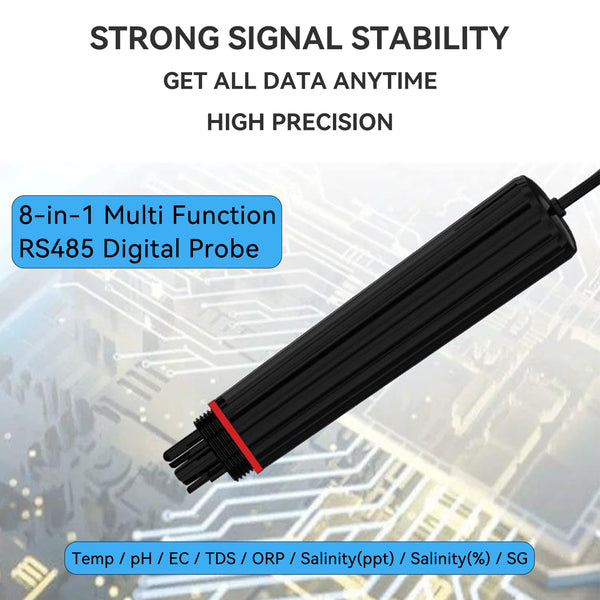
Your device
Product: 8-in-1 RS485 Digital Water Quality Probe
Device type: Standalone integration probe; display and app are not included
What it measures
Water temperature, pH, EC, TDS, ORP, salinity in ppt, salinity in percent, and specific gravity. It does not measure free chlorine.
Check your product label and hardware revision before following a wiring, button, calibration or storage procedure. For revision-specific details, contact Rovynel Support with your model and version.
Connection and power
Wired RS485 A/B output with DC 5-24 V input. A compatible USB-to-RS485 adapter may be selected separately where offered.
Setup and first reading
- Obtain the exact wiring and register document supplied for the probe version before installation.
- Record the approved supply voltage, RS485 settings, device address, byte order, scaling, and units.
- Connect power and RS485 A/B only after power is isolated and polarity is confirmed.
- Confirm raw communication before interpreting measurement values.
- Verify every register and unit against known or reference conditions.
- Complete the required parameter calibration and record standards, date, operator, and result.
Placement checklist
- Protect the cable and connector from strain, water ingress, and electrical-noise sources.
- Use representative flow and prevent bubbles or deposits from covering sensing surfaces.
- Follow the supplied storage requirements whenever a sensing element is out of service.
First-reading checklist
- Correct product and sensor type confirmed.
- Connection path and power state confirmed.
- Sensing surfaces inspected and placed in representative conditions.
- Units checked before comparing values.
- Required stabilization time allowed.
- Calibration or verification completed using the exact model procedure.
- Initial values compared with a suitable maintained reference method.
- Baseline and review date recorded before alert thresholds are used.
Calibration and reference checks
- Use only standards, reference methods, and steps specified for the exact product revision.
- Never invent or copy buffer values, calibration pass limits, register scaling, or storage liquids from another model.
- Record the standard lot or reference, date, operator, temperature where relevant, and result.
- Rinse and handle sensing surfaces according to the exact sensor requirements.
- Repeat verification after cleaning, unusual exposure, transport, long storage, or implausible readings.
Routine care
- Inspect for deposits, biofouling, bubbles, cable damage, loose connectors, condensation, and abnormal exposure.
- Keep displays, gateways, power parts, and non-immersible connectors dry.
- Do not scrape or chemically clean sensing surfaces unless the supplied instructions permit it.
- Keep a simple maintenance log with placement, calibration, cleaning, and unusual-event notes.
Troubleshooting
- No communication: verify DC input, A/B polarity, host serial settings, address, and register documentation.
- Implausible values: verify register type, byte order, scaling, unit conversion, and calibration state.
- Unstable values: inspect placement, bubbles, fouling, electrical noise, grounding, and stabilization time.
- Controller integration unknown: Do not claim compatibility until the host supports the exact electrical and protocol requirements.
Safe use and limitations
- Disconnect power before wiring, opening connectors, moving powered components, or servicing an RS485 installation.
- Keep children and animals away from cables, small parts, standards, cleaning liquids, and power equipment.
- Do not use the product as the sole basis for drinking-water, medical, life-support, food-safety, or emergency decisions.
- Do not claim regulatory certification unless the exact product label and supporting document identify it.
- Use the measured channels as trends and decision inputs, not as a substitute for every required test.
Keep a support record
When asking for help, include:
- Product model and SKU
- Purchase or order number
- Hardware or firmware version, if shown
- Date placed in service
- Last calibration or verification date and reference used
- Issue, units and observed readings
- Installation photos or controller logs, where applicable
Contact Rovynel Support about this model
Related guides
- Water quality parameters guide
- Setup and calibration overview
- Sensor accuracy and probe care
- Frequently asked questions
- Warranty and support
Online edition 1.0. Content reorganized October 7, 2026 from the existing model support page and Quick Start and Safe Use guide. Technical specifications remain those stated in the original model documentation.